Sixteen pitches, three countries, one standard: The quiet engineering behind the 2026 World Cup

Ask any grounds manager what their job looks like during a World Cup and the honest answer is that it is invisible. If the cameras find the pitch, something has gone wrong. The 23rd FIFA World Cup, which kicks off on 11 June at the Estadio Azteca and ends on 19 July at MetLife Stadium, has been designed from the turf up to keep things that way. The trouble is, this tournament has made that ambition harder to deliver than any in the competition’s history.
Forty eight nations. One hundred and four matches. Sixteen stadiums spread across Canada, the United States and Mexico, plus dozens of training base camps where the squads will prepare between fixtures. Every one of those surfaces must hold up to elite football, must feel the same underfoot whether the match is in Vancouver or Monterrey, and must do so on grass that, in many venues, only arrived a few weeks before the opening whistle. For the agronomists, lighting specialists and pitch researchers who have spent years preparing for this moment, it is also the most agronomically complex football tournament ever staged.

A different beast to Qatar
Comparisons with Qatar 2022 highlight how much the scale has shifted. In Qatar, the eight venues sat within a footprint smaller than greater London, with the two furthest apart separated by around 80 kilometres. Every pitch faced essentially the same challenge: keep cool season grass alive under the punishing heat of the Arabian Peninsula. Most of those stadiums had been purpose built for the tournament, with pitch environments designed from the ground up.
North America 2026 could not be more different. From Vancouver in the north to Monterrey in the south, the venues span more than 3,100 miles. They include coastal stadiums in Miami and Boston, an open air bowl at 2,200 metres of altitude in Mexico City, the dry desert basin of Arlington and the maritime climate of British Columbia. Each microclimate affects grass selection, growth rate, disease pressure and recovery times. A bermudagrass that thrives in Kansas City would struggle in Toronto in June. The cool season Kentucky bluegrass and ryegrass mix that handles the Pacific Northwest would slow to a crawl in Guadalajara.
FIFA has effectively committed to running 16 parallel agronomic programmes simultaneously, each with its own grass type, supply chain, installation window and set of in tournament risks. And the expectation, set out by FIFA’s senior pitch manager David Graham, is that a player in Philadelphia must experience exactly the same playing surface as a player in Guadalajara or Seattle.

When the home pitch is plastic
The second complication is the venues themselves. Unlike Qatar, none of the 2026 stadiums was built for this tournament. Most have a day job, and for many of those day jobs the surface is artificial turf. Eight of the 16 host venues, including MetLife, Mercedes Benz Stadium in Atlanta, AT&T Stadium in Arlington, NRG Stadium in Houston and SoFi Stadium in Los Angeles, normally host the NFL on synthetic surfaces. For the World Cup, those surfaces have been pulled out and replaced with natural grass installations that must be grown elsewhere, transported, stitched into a continuous playing surface, and nursed through eight weeks of elite competition.
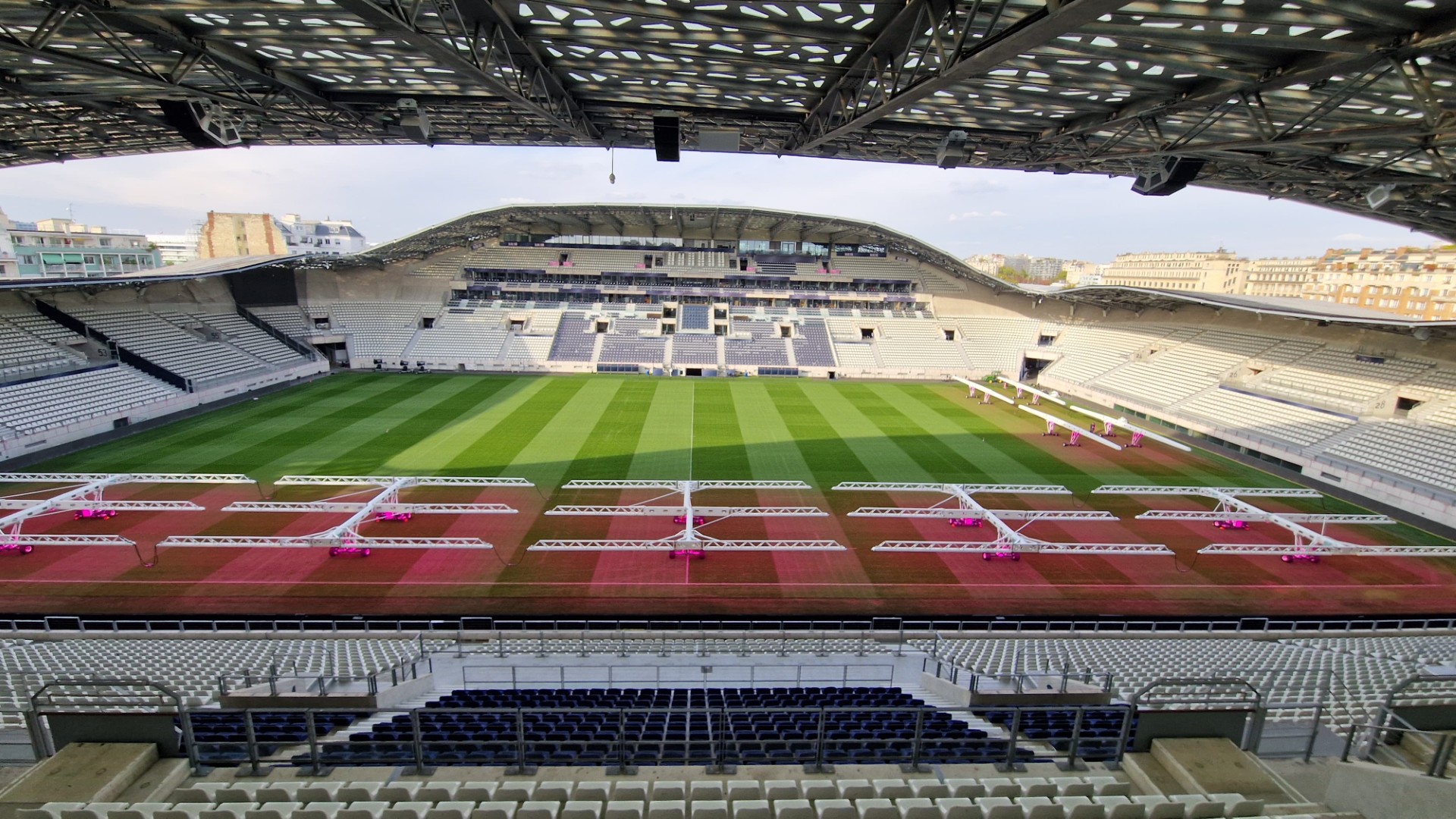
The trickier subset is the enclosed and partially enclosed venues. Five of the 16 have roofs of some form. NRG, AT&T and Mercedes Benz Stadium will keep their grass indoors throughout the tournament. SoFi sits beneath a translucent ETFE canopy. BC Place in Vancouver has a retractable roof. In each case the constraint is the same: there is not enough natural sunlight reaching the pitch to sustain healthy turf at the density FIFA demands. Without supplementary lighting, the grass simply will not photosynthesise enough to recover between matches.
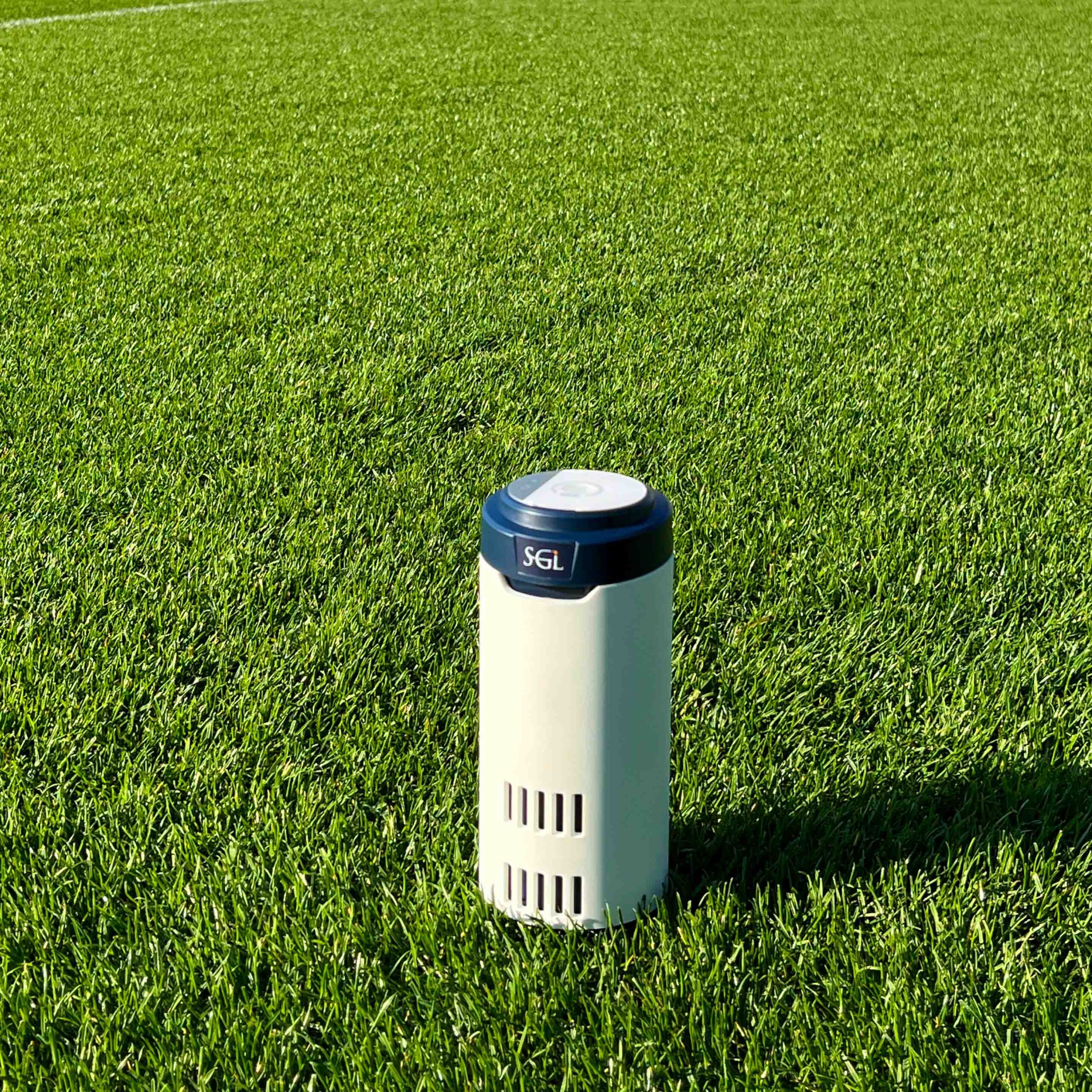
That constraint is where SGL, the Dutch pitch technology specialist whose grow lighting systems have become a fixture in elite stadia worldwide, becomes central to the story. Inside the domed venues, SGL grow lights are the practical mechanism by which a healthy natural grass surface is even possible. Beneath those banks of LED and HPS lamps, the grass receives the spectrum, intensity and duration of light it needs to photosynthesise, recover between fixtures and hold its density through the tournament. The same technology, in different configurations, is supporting venues that are nominally open air but shaded by stands or roof structures for parts of the day.

Years of research
That FIFA could even contemplate awarding eight matches to a building like NRG Stadium owes a great deal to research that began long before tickets went on sale. Under contract to FIFA, a team led by Dr John Sorochan of the University of Tennessee, with colleagues at Michigan State University, has spent roughly five years investigating the questions the 2026 tournament was always going to raise. Which grass species cope with reduced light? What spectrum and duration of supplementary lighting is most efficient and effective? How quickly can sod grown on plastic root into a sand based stadium pitch?
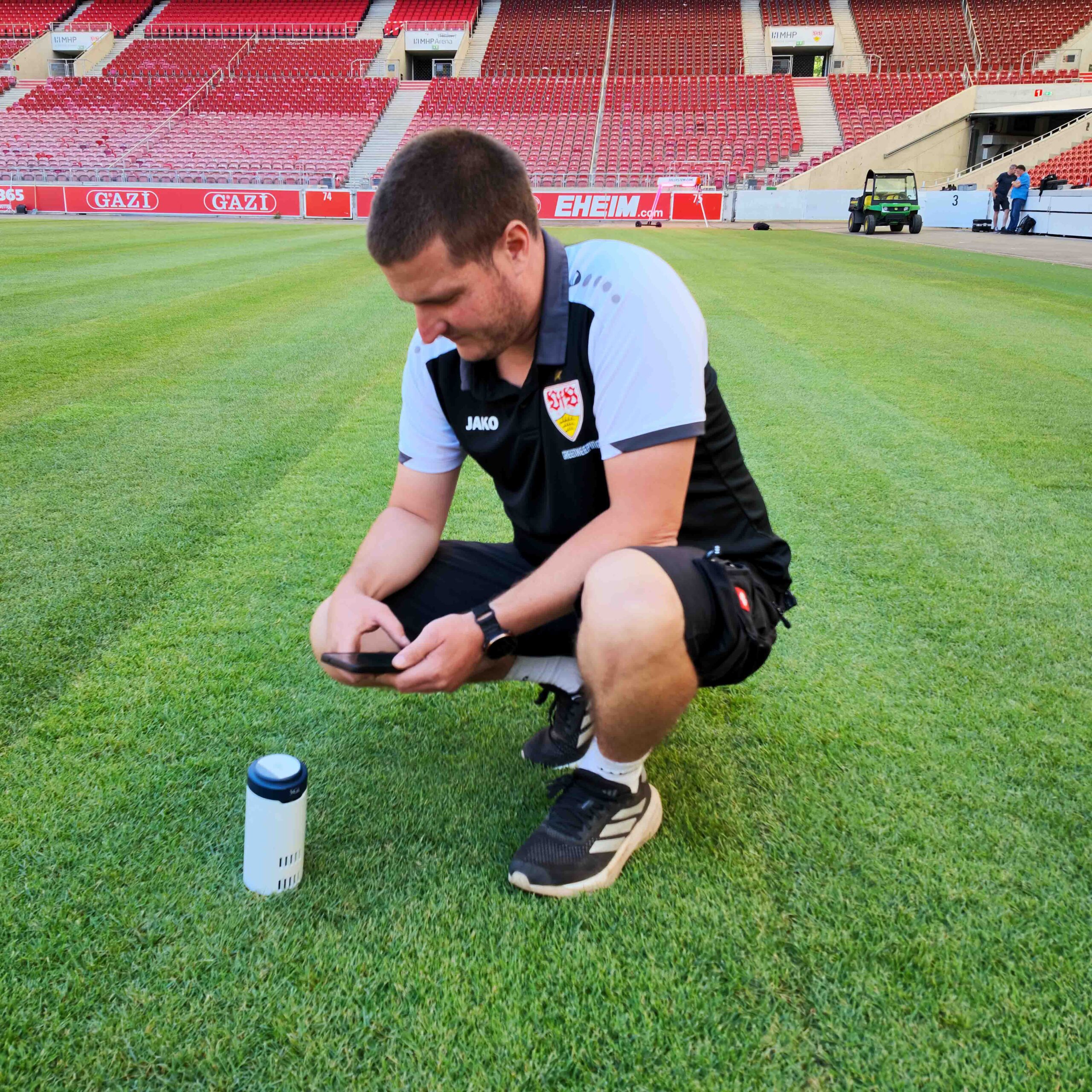
A purpose built FIFA research facility at the East Tennessee AgResearch and Education Center, the FIFA shade building, was constructed to replicate conditions inside the five domed venues. Different grasses, lighting recipes and soil profiles have been tested there in parallel, with findings fed into operational planning for individual host cities. SGL has been embedded in that research collaboration from an early stage. Its agronomists have worked alongside the Tennessee and Michigan State teams to translate laboratory findings into stadium ready lighting protocols, and the company’s data platforms have been used to log growth and climate conditions across the trial plots.
Track record from Johannesburg onwards
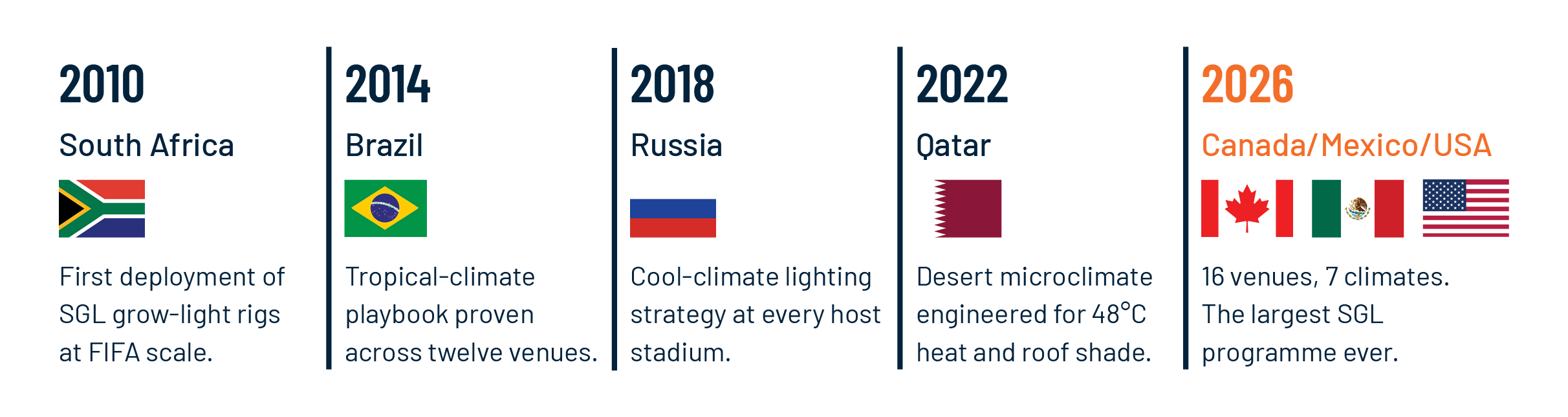
SGL is not new to this. The company’s stadium service was already being used in elite football by the time South Africa hosted in 2010, and successive tournaments in Brazil in 2014, Russia in 2018 and Qatar in 2022 each presented different lighting and climate puzzles that pushed the technology forward. Much of what was learned at those tournaments now feeds directly into the 2026 plan.
What is different this time is the breadth of the engagement. SGL is supporting all sixteen 2026 host venues, both on site through its agronomists and remotely through its data platforms, which feed light, climate and growth information back to a central team in Waddinxveen. For grounds managers operating under intense scrutiny, that combination of live monitoring, tournament experience and round the clock expert support is, more or less, the difference between confidence and guesswork. The same engagement extends to the training base camps used by the 48 squads, where pitch consistency between training and match day is no less important than the consistency between the stadiums themselves.
The behind the scenes contract
In a tournament defined publicly by its 48 teams, three host nations and the spectacle of an opening ceremony at the Estadio Azteca, the work happening on those pitches is unlikely to attract many headlines. That is rather the point. Every grounds team in North America is engaged in a quiet contract with the players and the watching world: get this right and nobody notices. For the agronomists, researchers and partners such as SGL working in support, the goal between 11 June and 19 July is for the grass to be the least interesting story of the tournament. If they succeed, it will look effortless. It will not have been.
Recent updates
Check out our latest updates