Growing a World Cup pitch
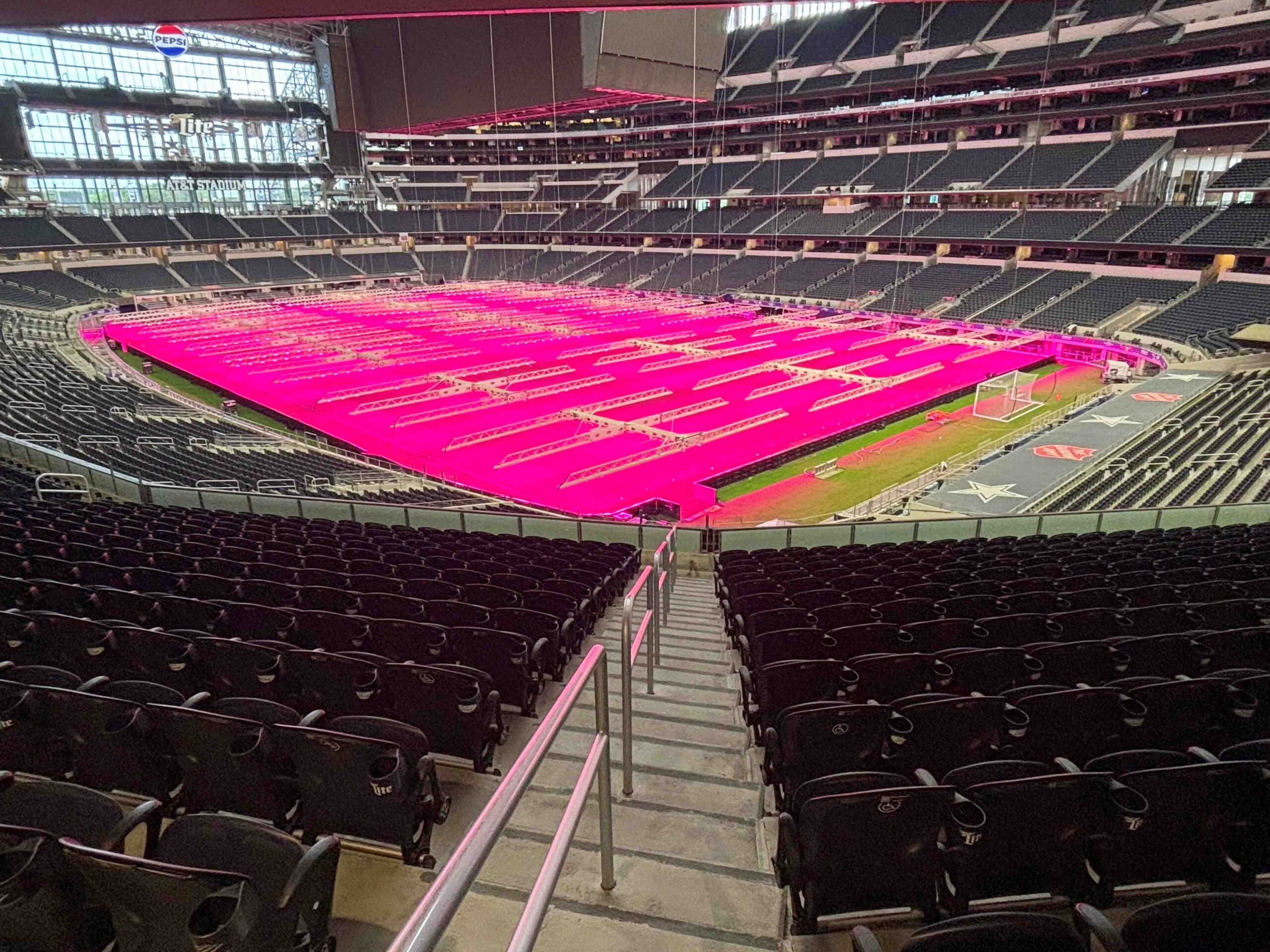
On 14 June 2026, the Netherlands and Japan kicked off the first World Cup match at “Dallas Stadium.” When they ran out, almost nothing under their feet looked like it did a few weeks earlier. The Dallas Cowboys’ artificial turf is gone. In its place is a thick carpet of real Kentucky bluegrass and ryegrass, lifted about two feet higher than the old field and made wider at both ends to fit a proper football pitch. Above it, for the past few weeks, the whole bowl has been glowing bright pink. That glow is the visible sign of years of preparation, and of a giant LED grow lighting system built specifically to keep this pitch alive indoors.
It’s one of the most ambitious indoor grass projects anyone has ever tried.

A World Cup that needs real grass
FIFA’s rule for 2026 is simple: every game has to be played on real grass. In Europe and South America that’s no big deal, since most clubs already play on natural pitches. But in the United States, most of the host venues are NFL stadiums built around artificial turf. That makes things tricky. AT&T Stadium in Arlington, which is hosting nine matches (more than any other venue), has the biggest job of them all. The project is overseen by General Manager Tod Martin.
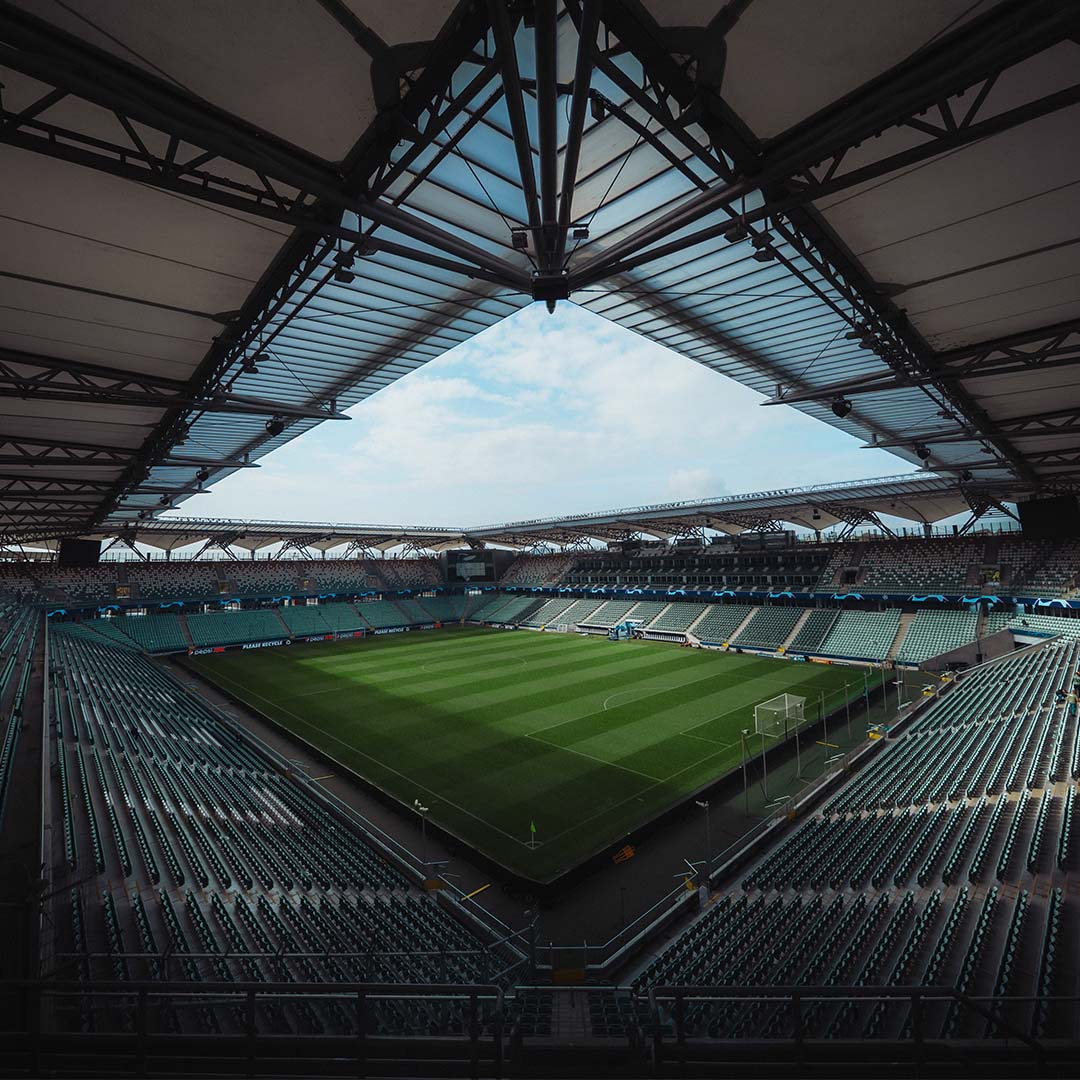
The stadium’s retractable roof, huge glass end-zone doors and tightly controlled climate are great for keeping fans cool in the Texas heat. They’re not great for growing grass. Even with the roof open, big parts of the field sit in permanent shadow. Cool-season grass needs daily light to stay healthy, and a closed bowl like this just can’t deliver enough of it on its own. For the World Cup that’s a serious problem: when nine matches across four weeks all have to be played on a surface that meets FIFA’s standards, the pitch can’t have an off day.
Solving that meant doing something no World Cup venue had tried before.

A full-pitch LED system hanging from the roof
To work out what was possible, FIFA brought in SGL early in the planning process. SGL has spent years working with FIFA on the question of how to keep elite natural grass healthy in places it shouldn’t really grow, and the team had already proved the principle indoors on previous projects. Arlington was a step up in scale and risk from anything that had come before. The answer SGL designed, was a full-pitch system that hangs from the roof and can be raised and lowered on cables.
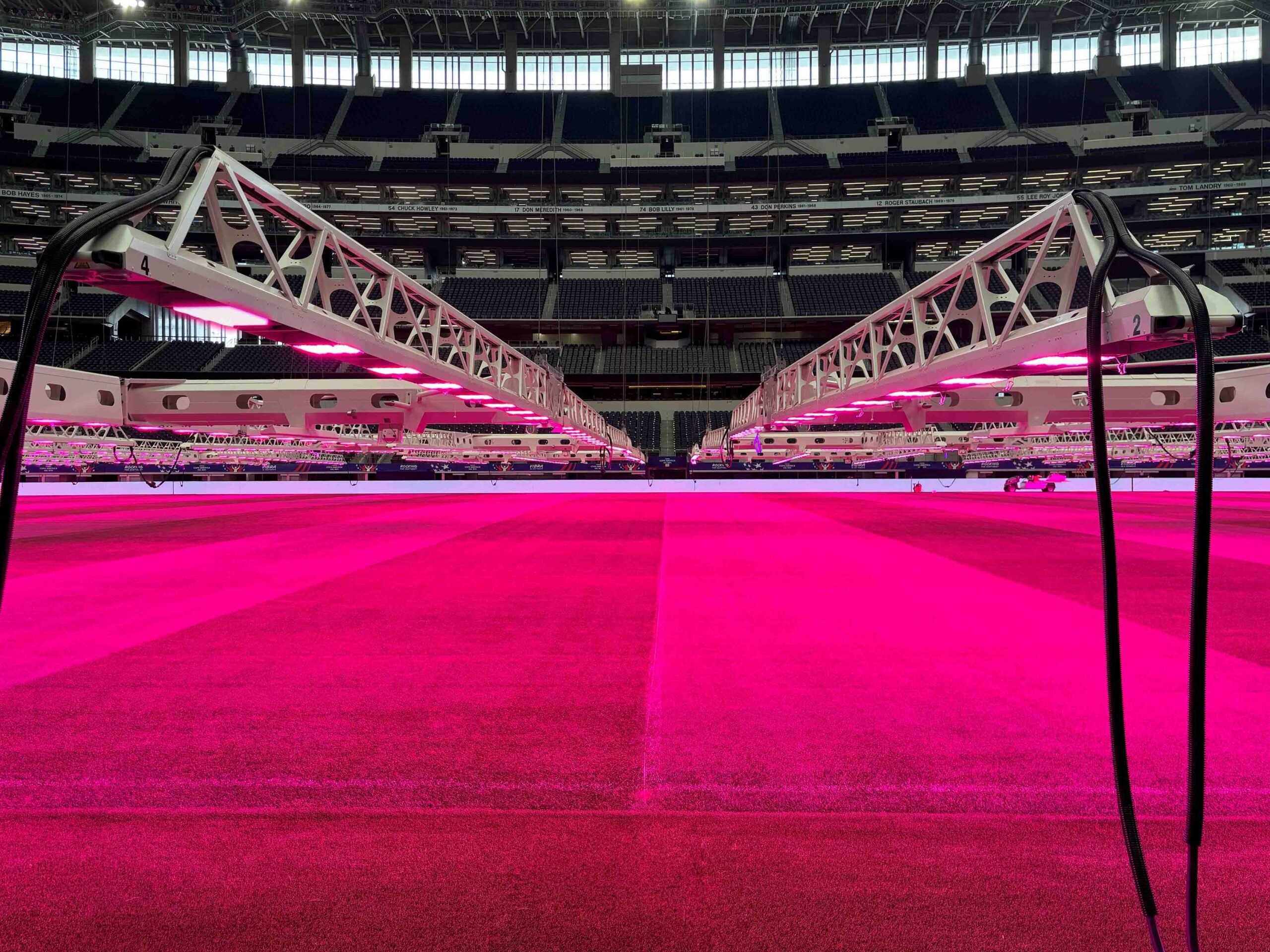
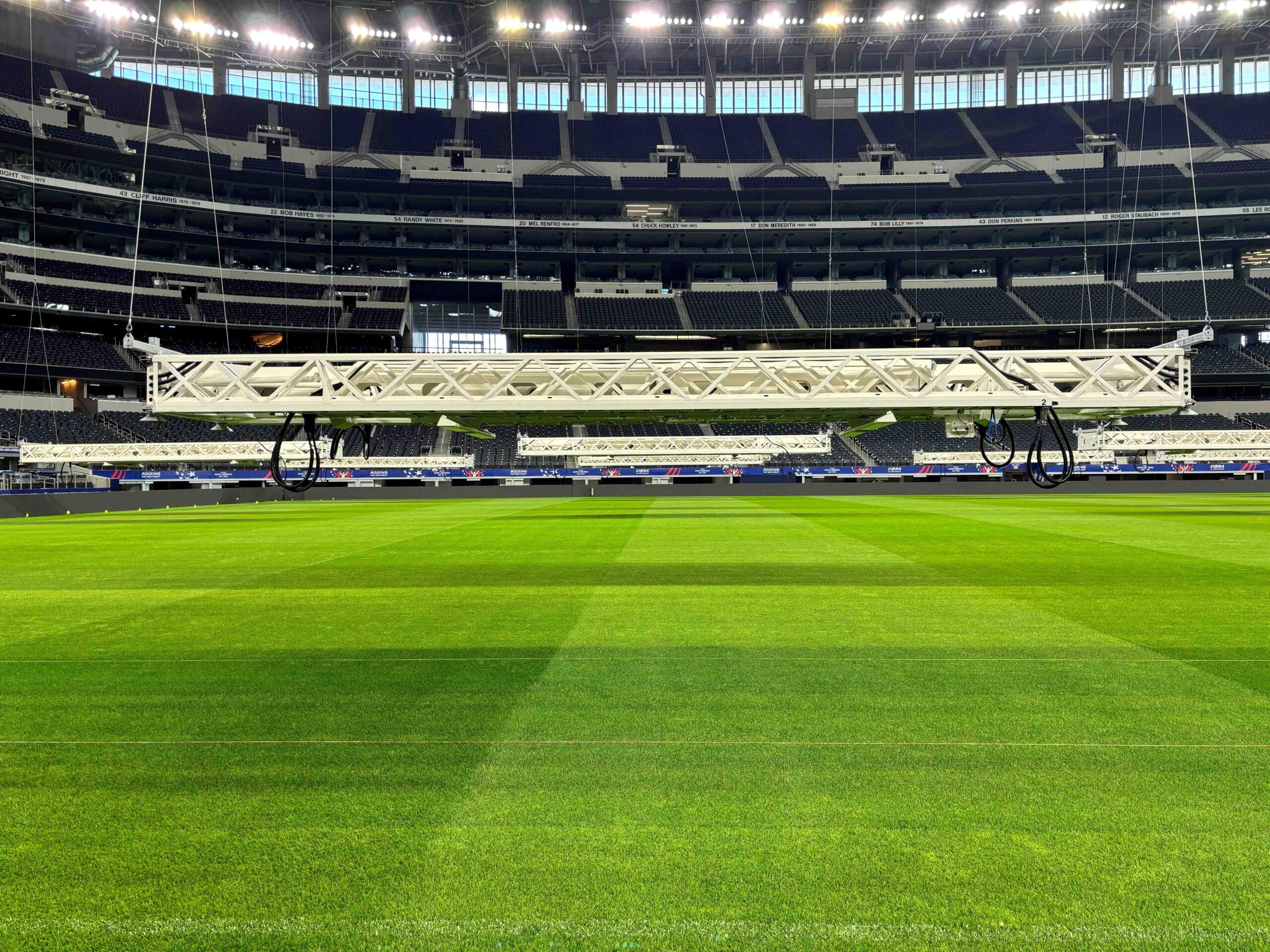
What you see in the stadium today is the result. Eighteen long white truss rigs hang above the pitch on cables. Each one carries rows of powerful LED panels designed to drive grass growth, and the mix of wavelengths coming out of those panels is what gives the bowl its bright magenta-pink glow. When the grass needs feeding with light, the rigs drop down close to the field. When it’s match day, they’re hoisted 290 feet up into the roof, where they’re out of every camera angle.
FIFA has called this a tournament first: no other 2026 World Cup venue uses a setup like it. Without it, the grass simply wouldn’t make it through nearly two months of play inside a building this closed-off.
Behind the scenes, the work of running the system is just as detailed as the work of designing it. SGL’s team draws on more than twenty years of data to fine-tune the pitch day by day. For FIFA, that ongoing oversight is part of the value: an experienced partner takes a lot of the risk out of staging the tournament here.

Building the pitch from the concrete up
The lights are only half the story. Underneath them is a full temporary grass pitch that was built from scratch in about six weeks.
Work started in early March on the stadium’s bare concrete floor. First came the irrigation pipes and ventilation system. Then about ten inches of sand were spread on top to give the grass and its roots something to grow in. The whole pitch ends up sitting about two feet higher than the Cowboys’ normal field. To make room for corner kicks and meet the official pitch size of 105 by 68 metres, crews even had to cut about three feet out of the lower seating bowl at each corner.

The grass itself was grown on a sod farm in Colorado and installed by the team of Eric Holland, founder of Precision Turf LLC. It was cut into rolls about four feet wide and fifty feet long, then trucked down to Texas in 24 refrigerated lorries before being laid down by Precision Turf in early May. Once it was in place, special machines stitched nylon fibres into the sod to make it tough enough to handle nine top-level matches in about four weeks.
Of all the moving parts, keeping the grass itself healthy is the highest-stakes job. The sand, the irrigation and the sod can all be installed and tested in advance, but the grass has to perform live, in front of the world, on dates that can’t move. Inside the stadium it stays at around 70–72°F, and almost no direct sunlight gets to the canopy through the roof. So the LED rigs keep photosynthesis going and push the grass into match shape. Between games the rigs drop back down, and a team of around 25 groundskeepers mow, water, feed and check the pitch for disease every single day, with SGL’s agronomists advising on the data coming off the system.
The goal isn’t just to make the pitch look good. It also has to feel right for the players: the way the ball bounces, how firm the surface is, how studs grip the turf. There’s data to back it up. The same lighting setup was first used here for the 2024 CONMEBOL Copa América matches, and FIFA also funded a five-year research project with the University of Tennessee and Michigan State University to figure out how to make this kind of pitch work. Arlington is the moment where all of that preparation meets the tournament it was built for.
Why this matters beyond Dallas
As more World Cup matches across North America move into stadiums with closed or partly closed roofs, the question of whether you can grow and keep top-level grass indoors for weeks at a time isn’t theoretical any more. Indoor natural grass has been done before, but usually only for short stretches. Arlington will be running like this for 63 or 64 days straight, effectively proving the idea can work for a full tournament.
If the pitch performs in June and July the way the tests suggest it will, the pink glow currently filling AT&T Stadium will mean a lot more than just one tournament. It’ll be the moment that growing World Cup-quality grass indoors, on demand, stopped being a one-off experiment and started becoming something other stadiums can rely on, with the technology and the experience behind it ready for whoever needs them next.
Everything about AT&T Stadium
 YouTube
CBS Texas
YouTube
FOX 4 Dallas-Fort Worth
YouTube
CBS Texas
YouTube
FOX 4 Dallas-Fort Worth
 Website
FIFA World Cup 2026™ Dallas Stadium
Website
FIFA World Cup 2026™ Dallas Stadium

 X / Twitter
GRASS IS HERE
X / Twitter
GRASS IS HERE
 YouTube
RTL Nieuws New York
YouTube
RTL Nieuws New York
Recent updates
Check out our latest updates